



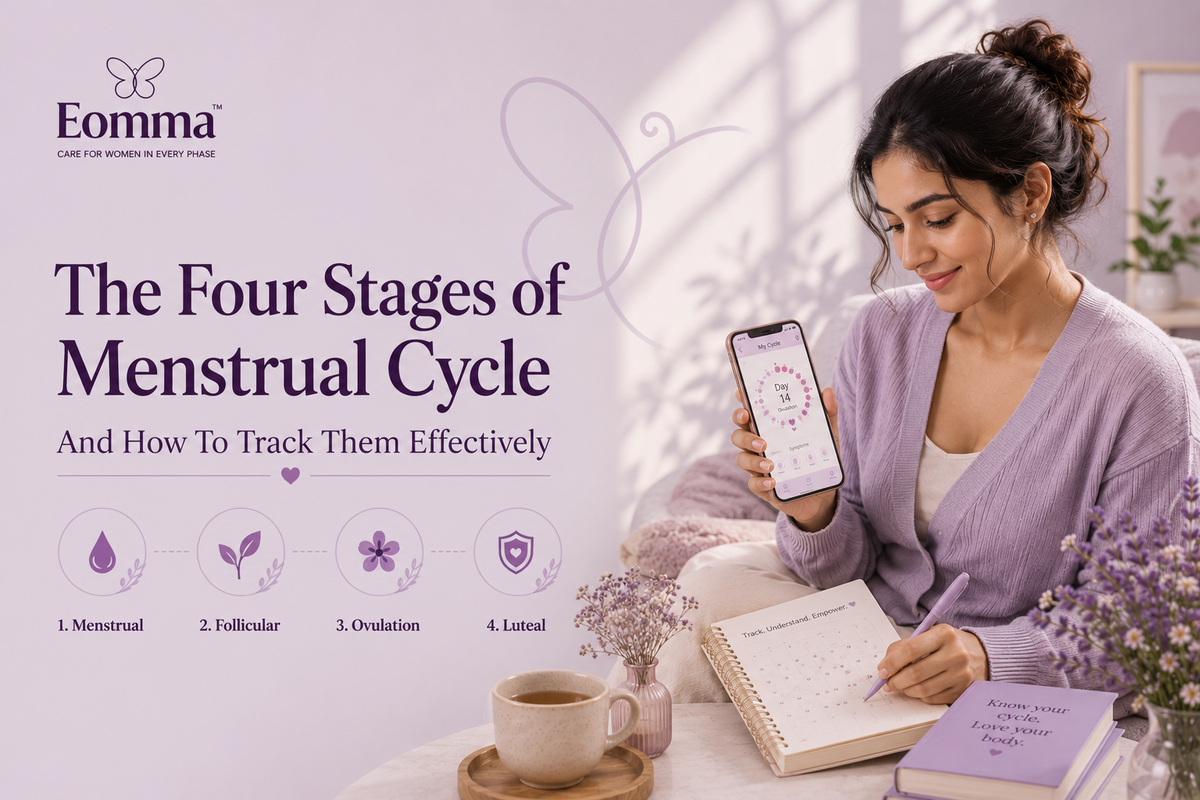
Most of us were taught that the menstrual cycle is just "the week you bleed." A nuisance to track, a cramp to survive, a box of supplies to keep stocked. But that's a tiny slice of a much bigger story.
Truth is, your menstrual cycle is a month-long hormonal rhythm, not just limited to your period. It is what quietly shapes your energy, mood, skin, appetite, and even your sleep, every single day. Once you understand that rhythm, a lot of things start to make sense. Why do you feel unstoppable some weeks and wiped out others? Why your cravings spike on schedule. Why does your patience run thin a few days before your period arrives?
But what do various stages of this cycle look like, and how do you keep track of it? By the end of this guide, you'll know which phase of the menstrual cycle you're in, what your body is asking for, and how to work with your cycle instead of fighting it.
What Is the Menstrual Cycle, Really?
The menstrual cycle is your body's monthly hormonal rhythm, the coordinated rise and fall of two key hormones, estrogen and progesterone. They prepare your body for the possibility of pregnancy and then reset when it doesn't happen.
It's counted from the first day of your period to the day before your next one begins. While the textbook cycle is 28 days, anything from about 21 to 35 days is considered normal and healthy. So if yours runs a little shorter or longer than the classic 28, you're in good company. There's a wide range of normal.
What matters more than the exact number of days is the pattern: the predictable arc your hormones travel each month. And that arc moves through four distinct phases.
The Four Phases of Your Menstrual Cycle
Here's where the stages come in. Each of the four menstrual cycle phases has its own hormonal signature, its own mood, and its own set of needs. None of them is "better" than another. They're a cycle for a reason. Knowing them is the difference between feeling at the mercy of your body and feeling fluent in its language.
Menstrual Phase (Days 1-5)
This is day one of your period, and the start of a brand-new cycle. Both estrogen and progesterone are at their lowest, which is exactly why energy often dips and you feel more inward and quiet.
This isn't a flaw to push through. It's a natural invitation to slow down. Prioritize rest, lean into iron-rich foods to replenish what you lose through bleeding, and choose gentle movement like walking or stretching over high-intensity workouts if your body asks for it. Comfortable, reliable period care makes this season far easier to move through.
During these days, what touches your skin matters just as much as what you eat or put on your face. Because your skin is especially sensitive right now, that's the thinking behind EOMMA Organic Sanitary Pads. Made from organic, biodegradable cotton, they are completely free from chlorine, synthetic fragrances, and harsh chemicals.
So the most sensitive skin on your body gets clean, gentle care during your periods. The breathable design helps cut down on heat and moisture for rash-free comfort. And high absorbency means reliable leak protection, so you can rest easy when your energy is already low. At INR 189 for a pack of 5, it's an easy way to give your body kinder care all month long. Try EOMMA Organic Sanitary Pads here.
Follicular Phase (Days 6-14)
As your period ends, estrogen begins to climb, and so does everything else. This is your follicular phase: energy returns, mood brightens, skin often looks clearer, and your mind feels sharper and more open to new ideas.
It's the perfect window to start projects, tackle challenges, and take on more demanding workouts. If you've been waiting for motivation, this is usually when it shows up on its own.
Ovulation (Around Day 14)
Estrogen peaks and triggers the release of an egg. This is the height of the cycle, ovulation. Many women feel their most energetic, confident, and social during this short window. It's also your most fertile phase — the few days when pregnancy is most likely, which is worth knowing whether you're trying to conceive or trying to avoid it.
Ovulation itself is brief, but the glow it brings is real. Use this energy where it counts.
Luteal Phase (Days 15-28)
After ovulation, progesterone rises to prepare the body for a possible pregnancy. In the early luteal phase, you may still feel steady and calm. But as this stage progresses and both hormones drop toward the end, it sets in: energy fades, cravings appear, and the familiar signs of PMS (irritability, bloating, low mood) can arrive in the final few days.
This is when self-care matters most. Steady your blood sugar with balanced meals, lean on magnesium-rich foods, slow your pace, and give yourself grace. The right wellness support during this stretch can take the edge off the toughest days of your cycle.
Why Your Cycle Changes How You Feel All Month
Here's the big shift in thinking: the way you feel across the month isn't random, and it isn't a character flaw. Your energy, mood, appetite, and sleep all track the rise and fall of your hormones with remarkable consistency.
The week you feel like you can conquer anything? That's likely rising and peaking estrogen. Do you feel like retreating from the world for a few days? Often, the hormonal dip of late luteal or menstrual phase. Once you see your month this way, you stop asking "what's wrong with me?" and start asking "which phase of the menstrual cycle am I in?" — a question with a much kinder, more useful answer.
How to Track Your Menstrual Cycle (and Why It's Worth It)
You can't work with a rhythm you can't see, which is exactly why learning how to track your menstrual cycle is so worthwhile. Tracking turns a vague sense of "ups and downs" into a personal map you can actually plan around.
You don't need anything fancy. The simplest methods include:
-
A calendar or cycle-tracking app: Log the first and last day of each period to learn your cycle length.
-
Symptom notes: Jot down energy, mood, cravings, sleep, and any pain each day. Patterns emerge fast.
-
Body signals: Over time, you'll start to recognize your own ovulation and PMS cues.
Track for two or three cycles and your personal pattern reveals itself: when your energy peaks, when PMS tends to hit, when to schedule the big presentation and when to protect a quiet evening. That's not a chore, that's self-knowledge you can use.
When Should You Talk to a Doctor
Cycles vary, and a wide range is perfectly normal, but some signs are worth a professional's attention. Consider checking in with a healthcare provider if you experience very irregular cycles, unusually heavy bleeding, severe pain that disrupts daily life, or a sudden, noticeable change in a pattern that was previously steady.
None of this is cause for alarm; it's simply about knowing your baseline well enough to notice when something shifts. When in doubt, a quick conversation with your doctor is always worth it.
Working With Your Cycle, Not Against It
Your menstrual cycle isn't a monthly inconvenience; it's a four-stage rhythm with its own logic, and learning to read it is genuinely empowering. When you stop fighting the phase you're in and start meeting your body where it actually is, everything gets a little easier.
The first step is simply paying attention. Start tracking, start noticing, and let your cycle become something you understand rather than something that catches you off guard.
This article is meant for general educational purposes. If you have concerns about your cycle, please consult a qualified healthcare provider.